Between iconoclasm and historiographic leap : U.S. Secret Assistance to the French Nuclear Program, 1969-1975
 |
| Richard Nixon and Georges Pompidou i, Reijavik, 31 May 1973. Credits : NARA |
The french nuclear deterrent is a subject that attracts many emotions within the public opinion of the Hexagone. As the main element of the “atomic monarchy” of the 5th Republic, it represents both the Grandeur of the country, but also its oppressive and absolutist side. In a way, it is a shard of the XVIIth century in contemporary France.
It is often presented as a wholly-independent program, in opposition to the british example which took advantage, from 1958 onwards, of a cooperation program with the United States, as well as the sale of vectors like Polaris and Trident. Very often, debates can be emotional, following the example of Unfit for Purpose by Benoît Pelopidas and Sébastien Phillipe in 2021.
However, this vision is oversimplified and does not stick accurately to facts.
If the Kennedy and Johnson administrations were not sympathetic to the french nuclear program, at the exception of the sales of the C-135 tankers, Washington’s position see a notable shift with the election of Richard Nixon. During his European tour after his inauguration, Nixon visits Charles de Gaulle in Paris and speaks about a new look on the french nuclear capacities. Dialogue only starts at the beginning of De Gaulle’s successor, Georges Pompidou, with a growing cooperation on three main domains : Optimisation of rocket propulsion, miniaturisation of thermonuclear first stages as well as nuclear weapons safety.
In terms of sources, the first elements about this secret assistance came from an article of Richard Ullman published in Foreign Policy in 1989. Titled “The Covert French Connection” (a reference to the heroin smuggling network), this article is based on a number of interviews which led to deduct a certain dynamic about relations between Paris and Washington towards nuclear issues
Then, the main course about sources is the digitalisation and publication of a large collection of declassified documents by William Burr for the Nuclear Proliferation International History Project in 2011. Offering 52 documents coming from offices in the Nixon and Ford administration, it is a high calibre collection.
The main interest of these documents is, of course, the possibility to speak about this secret assistance, which is way more modest than the one towards Britain. The objective of Nixon and Kissinger is very often to make the french “drool”, in order to balance power and alliances within the European partners of Washington
However, while they are asking, it would be false to think that the french are only begging. Even while they are definitely the “minor” partners in those unbalanced discussions, and that the Americans are dragging their feet, they don't really feel helpless. During those discussions, the French are speaking about the difficulties and the advances of their program (which is also a goal for the Americans, in order to keep tabs on them). These talks are happening while the French nuclear program is preparing the “operational thermonuclear stage” : the conception of optimized, safe and hardened warheads able to be fielded and to penetrate the ABM shield over Moscow. This can explain why France fielded thermonuclear weapons quite late in its history, and why its nuclear forces had to make do with interim fission and boosted warheads until the eve of the 1980s.
Two concrete examples, within the same document, can be pointed at. This document is a memorandum of conversation between Robert Galley, French Minister of Defense, Jean Blancard, Ministerial Deleguate for Armament and Henry Kissinger (then National Security Advisor) on August 31st 1973. During that exchange, the french delegation (then stopping by from Polynesia in their return trip to Metropolitan France) talk about the two last nuclear tests under balloon at Mururoa. Those, certainly shots Pallas and Parthénope, done on August the 18th and 24th respectively, are said to be successful tests of thermonuclear triggers, even if their yield is particularly low. Within this document and discussion, the two sides speak about the question of the penetration of the missile shield over Moscow. Jean Blancard tells about the upcoming presence of pen aids within the future french missile coming in service in 1976 (which is certainly the sub-launched M20), but tells that there won’t be chaff. This can lead to deduct that it would be inflatable false warheads decoys that would be present within the missile. The “Moscow Criterion”, Britain’s goal to destroy the Soviet Capital (and only it) is also mentioned, in a quasi-ironic tone.
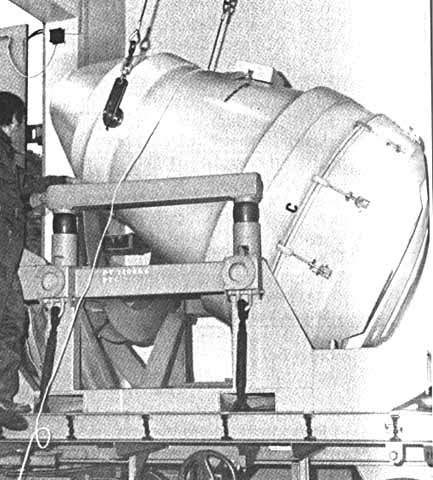 |
The TN 61, thermonuclear warhead (~1,2 MT) equipping the SSBNs from 1977 to 1991 and the
|
Because of the difficulty in acceding contemporary french sources on the subject, and because of their exceptional content, American sources are a very good choice for the study of the french military nuclear program. The study of those document necessitated being ready to be a little bit iconoclast and to put seriously into question the “wholly independent” French nuke, but the American assistance came as the French program proved its worth.
The nuclear dialogue between France and the US doesn't stop in 1976. However, traces are less easy to analyse. These discussions might still take place to this day, especially about nuclear weapons safety. JD Vance's declarations showing hostility towards the French and British nuclear stockpiles and deterrence forces could put those fruitful talks under threat ?
_________
Bibliography :
BURR William, « U.S. Secret Assistance to the French Nuclear Program, 1969-1975: From "Fourth Country" to Strategic Partner » [en ligne], Wilson Center [consulté le 28/08/2024]. Disponible sur https://www.wilsoncenter.org/publication/us-secret-assistance-to-the-french-nuclear-program-1969-1975-fourth-country-to-strategic
MOORE, Richard, Nuclear illusion, nuclear reality: Britain, the United States and nuclear weapons, 1958-64, New York, Palgrave Macmillan, 2010, 332 p.
PELOPIDAS, Benoît et PHILIPPE, Sébastien, « Unfit for purpose: reassessing the development and deployment of French nuclear weapons (1956–1974) », Cold War History, vol. 21 / 3, juillet 2021, p. 243-260.
TERTRAIS, Bruno et GUISNEL, Jean, Le Président et la Bombe, Odile Jacob, 2016.


Commentaires
Enregistrer un commentaire